Most businesses invest in SEO and expect instant results — but get frustrated when rankings don’t move fast.
Here’s the truth: how long does SEO take depends on strategy, competition, and execution quality — but with the right system, you can predict and accelerate results.
As an SEO strategist with 20+ years of experience, I’ll break down realistic timelines, ranking factors, and how to speed up your SEO growth using modern, AI-driven strategies.
What Does “How Long Does SEO Take” Really Mean?
What is the typical SEO timeline?
SEO is the process of improving your website’s visibility in search engines like Google. Results don’t happen instantly because search engines need time to crawl, index, and trust your site.
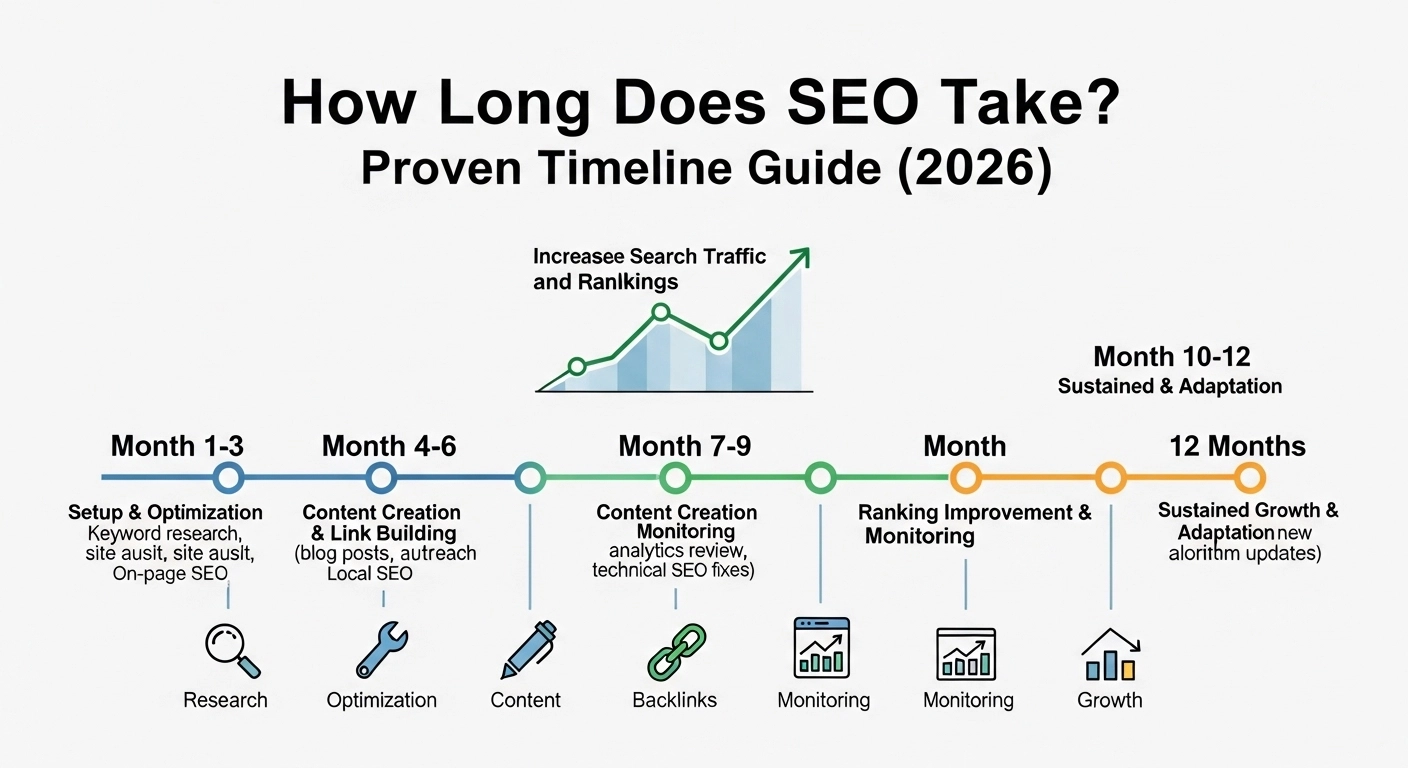
Standard SEO timeline:
- 0–3 months → Foundation + indexing
- 3–6 months → Early rankings + traffic growth
- 6–12 months → Strong organic traction
- 12+ months → Authority + dominance
Why SEO takes time to show results
Search engines evaluate:
- Website authority
- Content quality
- Backlink profile
- User experience signals
This evaluation process naturally takes time.
Why SEO Timeline Matters for Business Growth
SEO vs paid ads timeline comparison
- PPC → instant traffic, stops when budget ends
- SEO → slow start, long-term compounding growth
Long-term ROI of SEO investment
SEO builds:
- Sustainable traffic
- Brand authority
- Lower acquisition cost over time
How SEO Works: Timeline Breakdown Step-by-Step
Phase 1: Technical foundation (0–30 days)
- Site audit
- Fix indexing issues
- Improve Core Web Vitals
Phase 2: Content & keyword strategy (1–3 months)
- Keyword research
- Content creation
- On-page SEO
Phase 3: Authority building (3–6 months)
- Link building
- Content expansion
- Internal linking
Phase 4: Growth & scaling (6–12 months)
- Topic clusters
- Conversion optimization
- AI content expansion
Core Factors That Affect How Long SEO Takes
Website age and domain authority
Older domains rank faster due to trust.
Competition level in your niche
- High competition = slower results
- Low competition = faster wins
Content quality and consistency
Google prioritizes:
- Helpful content
- Topical authority
- Fresh updates
Backlink profile strength
High-quality backlinks accelerate rankings.
Technical SEO health
Poor site structure slows down SEO drastically.
Step-by-Step Strategy to Speed Up SEO Results
Step 1: Perform a full SEO audit
Identify:
- Broken pages
- Indexing issues
- Speed problems
Step 2: Build topical authority (MOST IMPORTANT)
Topical Authority Framework:
- Create pillar content
- Add supporting blog posts
- Interlink everything
Step 3: Target low-competition keywords first
Focus on:
- Long-tail keywords
- Question-based queries
Step 4: Publish high-quality content consistently
Minimum:
- 2–4 articles per week
Step 5: Build backlinks strategically
Focus on:
- Guest posts
- Niche edits
- Digital PR
Step 6: Optimize for AI search engines (2026)
AI SEO Checklist:
- Clear answers for queries
- Structured headings
- Entity-based content
- FAQ sections
SEO Pricing and Its Impact on Timeline
How budget affects SEO speed
- Low budget → slower growth
- High investment → faster scaling
Typical SEO cost ranges (USA)
- Freelancer: $500–$1500/month
- Agency: $2000–$10,000/month
- Enterprise: $10k+
How to Choose an SEO Strategy That Delivers Faster Results
Signs of a strong SEO strategy
- Data-driven keyword targeting
- Content clusters
- Technical optimization
Red flags to avoid
- “Guaranteed rankings”
- Cheap backlinks
- No reporting
Common SEO Mistakes That Delay Results
Targeting high-competition keywords too early
Leads to zero rankings.
Ignoring technical SEO
Kills crawlability and indexing.
Low-quality content production
Google ignores thin content.
Inconsistent publishing
Breaks momentum.
Advanced SEO Strategies to Reduce Timeline (2026)
AI-powered content optimization
Use AI tools for:
- Content briefs
- Semantic coverage
- NLP optimization
Topical authority domination
Cover entire topics, not just keywords.
Entity-based SEO
Focus on:
- Topics
- Relationships
- Context
Programmatic SEO (scaling strategy)
Create:
- Thousands of optimized pages
- Automated content systems
FAQs (Featured Snippet Optimized)
How long does SEO take to work?
SEO typically takes 3 to 6 months to show noticeable results, but competitive niches may require 6–12 months for strong rankings.
Can SEO work in 1 month?
You may see indexing and minor improvements, but meaningful traffic growth usually takes longer.
Why is SEO so slow?
Because search engines need time to evaluate trust, authority, and relevance before ranking your site.
What is the fastest way to rank on Google?
Target low-competition keywords, publish high-quality content, and build strong backlinks.
Does domain age affect SEO speed?
Yes. Older domains often rank faster due to established authority and trust.
Is SEO faster than paid ads?
No. SEO is slower initially but delivers long-term sustainable results compared to ads.
How many blog posts are needed for SEO?
Typically 30–100+ high-quality articles are needed to build strong authority in a niche.
Conclusion
SEO is not instant — but it is predictable.
If you understand the factors that influence rankings and apply a structured strategy, you can significantly reduce the time it takes to see results.
The key is consistency, quality, and authority-building — not shortcuts.
If you’re serious about growth, start building your SEO foundation today and treat it as a long-term asset, not a quick win.

This username suits someone who adds a magical touch to words. WordAura makes captions feel elegant, deep, and soulful, leaving a lasting impression on readers.
Explore More Helpful Resources
Improve your English skills with practical grammar explanations and useful lessons from Gramors.
Explore modern English usage, vocabulary tips, and language guidance through Languvio.
Discover clearer word meanings and writing insights with LexMints.
Build stronger sentences and improve your writing style with resources from SentenceMint.
Find detailed grammar guides and practical examples at GrammarExplore.
Strengthen your grammar foundation with easy explanations from GramVora.
Understand complex grammar rules and language usage with Grammaticalness.
Expand vocabulary and discover better word choices through Lexivorix.
Explore fascinating words and definitions with Wordiora.
Improve English communication skills with practical resources from EnglishRoleBook.
Learn smarter ways to avoid common English mistakes with GrammarEgo.
Explore English learning resources and language opportunities through GrammarJobs.
Find useful writing answers and communication tips from ResponcesHub.
Build your English foundation with lessons from LearnEnglishGrammars.
Access clear grammar explanations and examples from EnglishGrammarHub.
Learn grammar step by step with structured guides from EnglishGrammarLessons.
Master essential grammar rules through BasicEnglishGrammars.
Solve grammar confusion with helpful explanations from GrammarPilot.
Improve writing accuracy with practical advice from GrammarPeak.
Fuel your English improvement journey with GrammarsFuel.
Explore more English learning ideas through EnglishGrammarlly.
Discover simple writing improvement methods with GrammarlyWay.
Explore deeper meanings and explanations with MeaningMinds.
Discover stories and meanings behind words through MeaningMuse.
Understand difficult concepts with simple guides from MeaningSage.
Find clear definitions and interesting meanings at MeaningOra.
Explore symbols, traditions, and cultural meanings with Symbolara.
Discover symbolism history and interpretations from SymbolicSphere.
Learn about traditional symbols and their meanings through DeepSymbols.
Discover what symbols represent across cultures with SymbolCodex.
Explore fascinating symbolism guides through Symblio.
Understand connections between symbols and culture with SymbolNexus.
Learn how symbols developed over time through SymbolOrigin.
Explore symbolic interpretations with SymbolOracle.
Discover meanings behind important symbols from Symbolora.
Explore ancient symbolism and cultural stories with SymbolLore.
Discover deeper symbol meanings through Symbolistry.
Learn about symbolic designs and historical meanings from Sigilica.
Explore meaningful symbols and interpretations at SymbolicEssence.
Discover dream themes and symbolic ideas through DreamMyths.
Compare choices with clear breakdowns from CompareVex.
Explore side-by-side comparisons through VSCompareLab.
Make informed decisions with comparison guides from CompareChoiceX.
Review differences and options with VarioCompare.
Explore celebrity profiles and entertainment insights from FameOrbits.
Discover celebrity facts and profiles through CelebCrest.
Stay updated with technology guides from TechViore.
Explore mobile app resources through APKVerO.
Discover Android and app information with APKivo.
Find creative online resources through CoverVesto.
Explore helpful educational resources from Avliera.
Explore helpful digital resources and practical guides through Serphixa.
Discover wellness ideas, fitness insights, and lifestyle resources from FitNoova.
Find additional online resources and useful information through SerfHexa.
Explore more helpful guides and digital resources with SerpHexa.
Learn more about financial insights and useful resources from Finssure.
Improve grammar understanding with clear explanations from GrammarClarity.
Explore practical grammar lessons and writing tips through GrammarMint.
Find creative slogan ideas and branding inspiration with Sloganifiy.
Discover creative captions, ideas, and inspiration from Picklinezz.
Understand confusing words and language differences through LingoClarity.
Find simple definitions and clear explanations with DefineBly.